





Account
Guest
Biotin or Peptides for Thinning Hair? The Real Answer

Biotin or Peptides for Thinning Hair? The Real Answer

Posted By JC

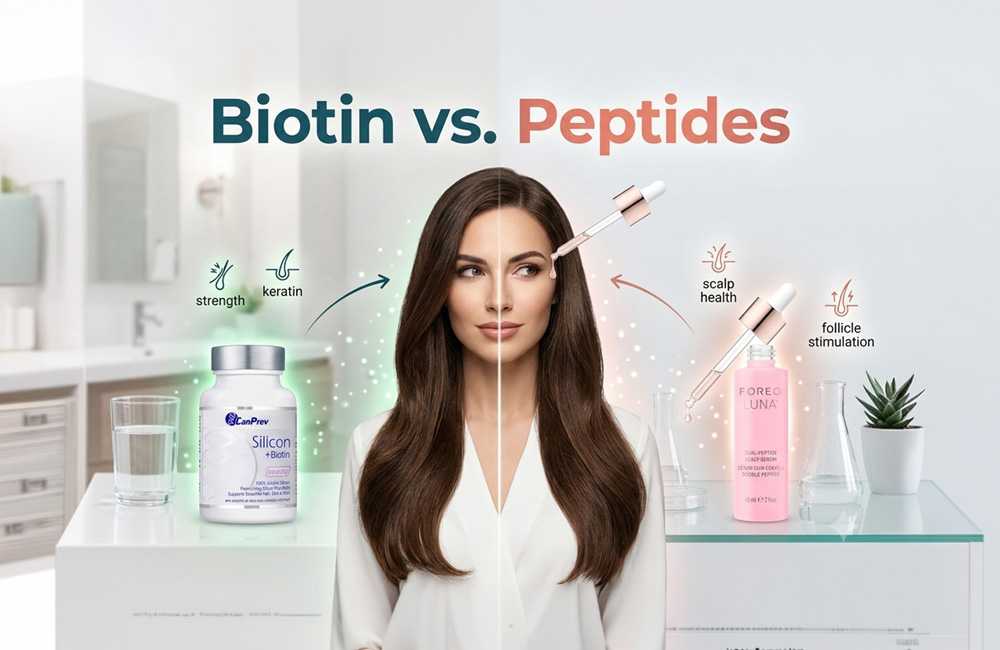
If your feed has been serving you biotin gummies in one ad and peptide scalp serums in the next, you're not imagining the noise. Thinning hair sends most of us straight to the ingredient list, and biotin and peptides are the two names that come up again and again. But they don't do the same job, and treating them as interchangeable is where most routines go wrong. One works from the inside, one works at the follicle, and knowing the difference changes what you should actually expect from either one.


Let's get into what's real, what's overstated, and whether your hair benefits more from one, the other, or both.

Why This Hair Growth Comparison Matters More Than It Seems

Thinning hair rarely has one cause, which is exactly why a single-ingredient fix so often disappoints people. Genetics, hormones, stress, nutrient gaps, and scalp condition can all be pulling on hair density at the same time, and biotin and peptides sit on completely different sides of that equation. Picking the wrong tool for your specific type of hair loss is the most common reason a "proven" ingredient feels like it did nothing.


Before spending on either, it helps to know what each one is actually built to fix — and just as importantly, what it was never designed to fix in the first place.

Biotin: The Supplement Everyone Reaches For First

Biotin, or vitamin B7, is a cofactor in the enzymes that help convert nutrients into keratin, the structural protein your hair is built from. That's the biological basis for the biotin-hair connection, and it's real. The catch is that biotin only meaningfully improves hair growth when you're actually deficient, and true hair-related deficiency is uncommon in people eating a reasonably varied diet.

This is the part supplement marketing tends to skip. If your levels are already sufficient, adding more biotin doesn't give your hair follicles extra fuel to work with—it's not a hair-growth volume knob. Most of the visible hair improvement people report after starting a biotin regimen lines up with populations who had an underlying gap: restrictive diets, certain medications, pregnancy, or gut conditions that affect absorption and, in turn, hair health.

"More actives at once usually means more scalp irritation, not more hair."

If none of that applies, biotin isn't doing anything—it's just not the lever that moves hair density on its own. It's a support player, not the treatment.

There's also a dosing reality worth knowing: most biotin supplements marketed for hair contain far more than the body can actually use at once, since biotin is water-soluble and excess is simply flushed out rather than stored for later. Megadosing doesn't accelerate hair growth — it just produces more expensive urine. If you suspect a genuine deficiency, a blood test and a conversation with your doctor will tell you more than trial and error with gummies ever will, and it also rules out other nutrient gaps — iron and vitamin D deficiencies both mimic hair thinning and get mistaken for a biotin problem constantly.


Peptides: A More Targeted Signal


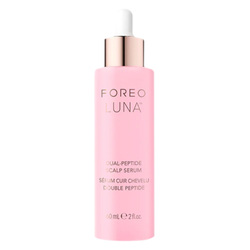
Peptides are short chains of amino acids that act as messengers rather than raw material. Instead of feeding the follicle, they tell surrounding cells what to do — extend the growth phase, improve circulation to the area, or calm inflammation that can shorten a hair's lifespan. This is the fundamental difference: biotin supplies a nutrient, peptides deliver an instruction.


Because peptides work at the site of the problem, they're typically applied topically rather than taken orally, and results depend heavily on formulation and delivery—a peptide serum that can't penetrate to the follicle won't do much, regardless of what's on the label.


The evidence here is promising but still developing. Peptides don't carry the decades of nutritional research biotin has behind them, and much of the strongest data comes from smaller or cosmetic-industry trials rather than large independent studies. That doesn't make them ineffective — it means expectations should stay realistic.


Peptides tend to shine with follicle miniaturization — the gradual shrinking that produces finer, shorter strands and is often the earliest sign of pattern thinning. Because they act locally, peptides can support a follicle that's still active but underperforming, a different problem than a nutrient shortfall. That's also why peptide treatments increasingly pair with scalp care rather than stand alone—a congested scalp can blunt even a well-designed peptide's reach.


Biotin vs. Peptides: The Practical Differences

Putting the two side by side makes the decision easier than any single article claiming one "wins."


Neither one is a fast fix, and that's worth sitting with before you invest in either. Hair growth cycles run in months, not weeks, so any product promising visible density in two weeks is selling urgency, not biology.


It's also worth noting that these two options don't address every cause of hair loss. Androgenetic alopecia, autoimmune conditions like alopecia areata, and thyroid-related shedding all have their own treatment pathways, and neither biotin nor peptides substitute for that care. If your hair loss is sudden, patchy, or accompanied by scalp pain or visible inflammation, that's a dermatologist visit, not a shopping trip. The routines below are built for the more common scenario: gradual, diffuse thinning without an underlying medical diagnosis.

Can You Combine Them?

Yes—and for a lot of people, this is where the actual strategy lives rather than in picking a side. Since biotin supports the internal building blocks and peptides work at the follicle surface, they're addressing different stages of the same process rather than competing for the same job.

A simple way to layer them:

  • Morning: Peptide serum applied directly to the scalp on clean, dry hair.
  • Ongoing: Biotin only if a healthcare provider has confirmed a deficiency or a dietary gap.
  • Avoid: Stacking multiple active scalp treatments (peptides, retinoids, strong exfoliants) at once—irritation undercuts the very growth phase you're trying to protect.

The pairing makes sense conceptually, but it's not a reason to add every hair product with either ingredient on the label. More actives at once usually means more scalp irritation, not more hair.

How to Choose a Product

Ingredient lists are only half the story — concentration and formulation matter just as much as what's in the bottle.

  • For biotin, look for a documented dose (most research uses ranges far higher than what's in a typical multivitamin) and consider whether a supplement is even the right call or whether addressing the dietary gap directly is.
  •  
  • For peptides, check where they sit on the ingredient list—peptides listed near the end of a long formula are likely present at a cosmetic, not functional, concentration. Look for products that pair peptides with penetration-supporting ingredients rather than peptides alone in a heavy, occlusive base that never reaches the scalp.


“Hair doesn't rush, and neither should your judgment of what's working.”

The Bottom Line

Biotin and peptides aren't rivals—they're tools built for different parts of the hair growth story. Biotin earns its place when there's an actual deficiency behind your thinning hair; peptides earn theirs by working directly at the follicle regardless of your nutrient status. Understanding which gap you're actually trying to close is more useful than chasing whichever ingredient is trending this month.


If you're building a routine around either, pair it with genuine patience. Hair doesn't rush, and neither should your judgment of what's working.


Quick recap for your hair care routine:

  • Deficient in biotin, or unsure? Get tested before you supplement heavily.
  • Noticing finer, shorter strands or a widening part? A peptide-based scalp serum is the more targeted starting point.
  • Doing both? Keep the rest of your scalp routine simple so irritation doesn't cancel out the hair growth support you're layering in.


New Subscribers get 10% Off

SUBSCRIBE
*Offer only for new subscribers and select brands only.
No spam. Unsubscribe at any time.
eSkinCareStore

by Eternal Skin Care

120-100 East 1st Street
North Vancouver, BC V7L1B1
Canada
Copyrights 1999-2026

Now Shopping

Canadian Flag
US Flag

Payment Methods

payment methods

Credentials

This site is protected by VikingCloud's Trusted Commerce program Click for the BBB Business Review of this Day Spas in North Vancouver BC
Eternal Logo

Eternal Skin Care ®
120-100 East 1st Street
North Vancouver, BC V7L1B1
Canada
Copyrights 1999-2026

Welcome Back

Account Home
Previous Orders
Order Status
My Loves
Sign Out

Don't Have An Account?

Start Here if you are new to our website.

CONTINUE
FORGOT PASSWORD
Don't remember your password, please enter your email and we'll send you a link to reset your password.
small logo
SAVE 10%
on your first order*
Subscribe and receive promotional offers and stay up to date with new trends in beauty and well being.
SIGN UP
*Offer only for new subscribers, excludes certain brands.
One-time promo code will be sent via email.
By entering your email, you agree to receive newsletters from eSkinCareStore.

1.866.336.7546


NEED HELP
Loading

1.866.336.7546


Feedback
Contact us
Live chat
Added To Cart
COOKIES!
We use cookies to improve your browsing experience and help us improve eSkinCareStore.com. By using our site, you agree to use of cookies as described in our cookie policy